
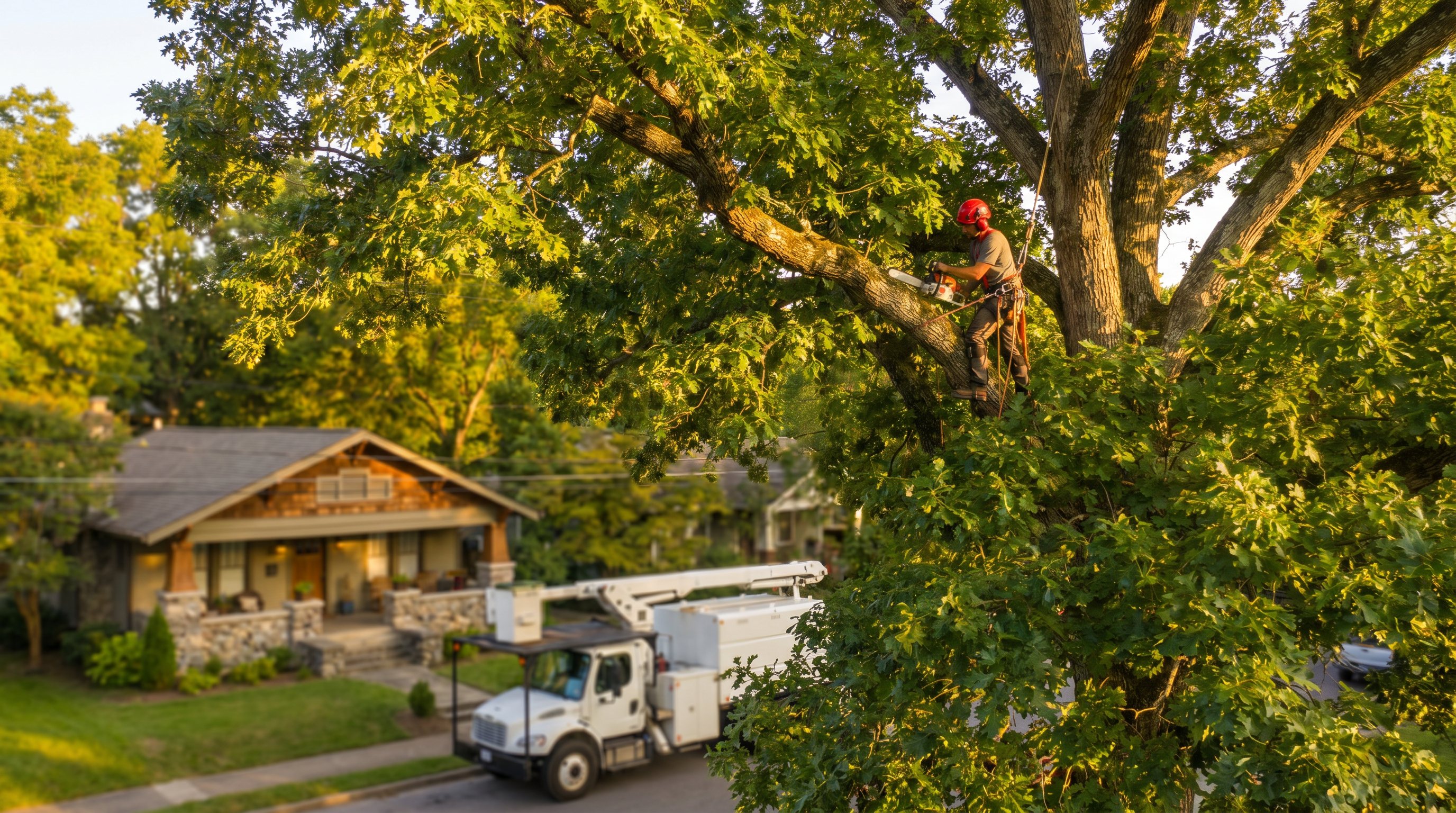
East Tennessee has two predictable severe-weather windows: spring thunderstorms from March through June, and winter ice events from December through February. The tornadoes, straight-line winds, and ice storms that come through Knox County every year don't usually break healthy trees — they break compromised ones. Which means most storm damage is preventable if you know what to look for.
This is the 30-minute pre-storm-season walk-around we recommend to every Knoxville homeowner.
Do This Twice a Year
Set a calendar reminder for the first weekend of March (before spring storms) and November (before winter ice). Walk every tree on your property with this checklist.
The 30-Minute Tree Walk-Around
1. Scan the Canopy for Dead Wood (5 min)
Stand back 30–50 feet from each tree. Look up. Are there any obviously dead, gray, leafless branches in the canopy — especially in spring or summer when leaves are out elsewhere?
Dead branches at the top of the canopy are the most common projectiles in a thunderstorm. Even a small dead limb dropping from 50 feet up can break a window or dent a vehicle. Action: note them, get them removed by a pro before storm season.
2. Look for Leaning That Got Worse (3 min)
Compare each tree to a known vertical reference — your house, a fence post, or a utility pole. Has the tree shifted noticeably since last year? Check the soil around the base for cracks, heaving, or exposed roots on the opposite side from the lean.
Action: a tree that's actively tilting is a tree that will fail. Book a hazard assessment immediately.
3. Check Branch Unions for V-Shapes (5 min)
Walk close to each tree and look at the major branch attachments to the trunk. U-shaped unions are strong. V-shaped unions — especially with bark "pinched" between the branches — are weak.
Common offenders in Knoxville: Bradford Pear (almost all of them), Tulip Poplar, Bradford-derived ornamental pears, and older Silver Maples. Action: get a pro to evaluate. Sometimes cabling solves it. Sometimes the limb needs to come off.
4. Look at the Trunk Base for Decay (3 min)
Walk all the way around the trunk. Look for:
- Mushrooms or shelf fungi (conks) — indicates internal decay
- Cavities, holes, or hollows
- Soft or "spongy" bark when you press it
- Carpenter ant activity
Action: any of these = hazard assessment. Decayed trees fail in light wind.
5. Inspect for Crossing/Rubbing Branches (3 min)
Branches that rub against each other in wind eventually wear through the bark and create wounds — entry points for disease. In storms, they're also the first to break because the constant rubbing has weakened them.
Action: note them for winter pruning.
6. Check Clearance Over Roofs, Driveways, and Power Lines (3 min)
Are any branches actively touching your roof, scraping against siding, hanging over your driveway low enough to hit a truck, or growing into the KUB power line easement?
Action: these get pruned for clearance. Branches over the roof are the #1 cause of preventable roof damage in Knoxville storms. Branches in power lines you don't touch — call KUB or a tree service to coordinate.
7. Walk the Perimeter for Storm Damage From Last Time (5 min)
Look for evidence of past damage you may not have dealt with: large dead limbs hanging caught in the canopy ("widow-makers"), partially broken branches still attached, bark torn vertically off the trunk. These don't get better on their own.
8. Photograph Anything Concerning (3 min)
Take wide and close-up photos of any concerns. Three reasons:
- Easier to show a pro for a remote opinion
- Establishes baseline if the tree later fails (for insurance)
- You can compare year over year
The Knoxville Storm Damage Patterns We See
Across Knox County storm-response calls, the same failure patterns repeat:
- Spring (March–June): straight-line winds break tops out of Tulip Poplars and Shortleaf Pines. Bradford Pears split at the trunk.
- Summer (July–September): microburst-soaked ground lets full trees uproot. Most common in West Knoxville and Farragut where lots have clay-heavy soils.
- Winter (December–February): ice loading breaks branches off of Pine, Magnolia, and any tree with horizontal limbs. The 2015 and 2022 ice storms left half of Knoxville without power.
What Pre-Storm Pruning Actually Does
A professionally pruned tree:
- Has less dead weight to throw in wind
- Resists wind loading better (the canopy is "thinned" so wind passes through instead of pushing the whole tree)
- Has had structurally weak branches removed proactively
- Sheds ice more cleanly
It's not a guarantee — nothing is. But the data is clear: well-maintained trees fail dramatically less than unmaintained ones, even in the same storm.
What Insurance Won't Pay For
Important reminder: Tennessee homeowners insurance generally does NOT cover the cost of removing a healthy living tree, even if you're removing it because you're worried it'll fall. It also won't cover preventive pruning. Out-of-pocket only.
Insurance covers tree-on-structure damage after the failure. If you're trying to prevent the failure, that's your investment to make.
Schedule a Pre-Storm Hazard Walk
We do free hazard walks across Knox County. We'll point out exactly what we see, prioritize by risk, and give written estimates for what should be done. Most homeowners come out of it with a 1–3 hour project, not a $5,000 bill.
Call (865) 348-3063 to book.
Related: 7 Signs Your Tree Is Dying · When a Tree Falls on Your House