
Last updated: May 2026. Sources include the University of Tennessee Extension, USDA Forest Service, International Society of Arboriculture, and the Tennessee Department of Agriculture, Division of Forestry.
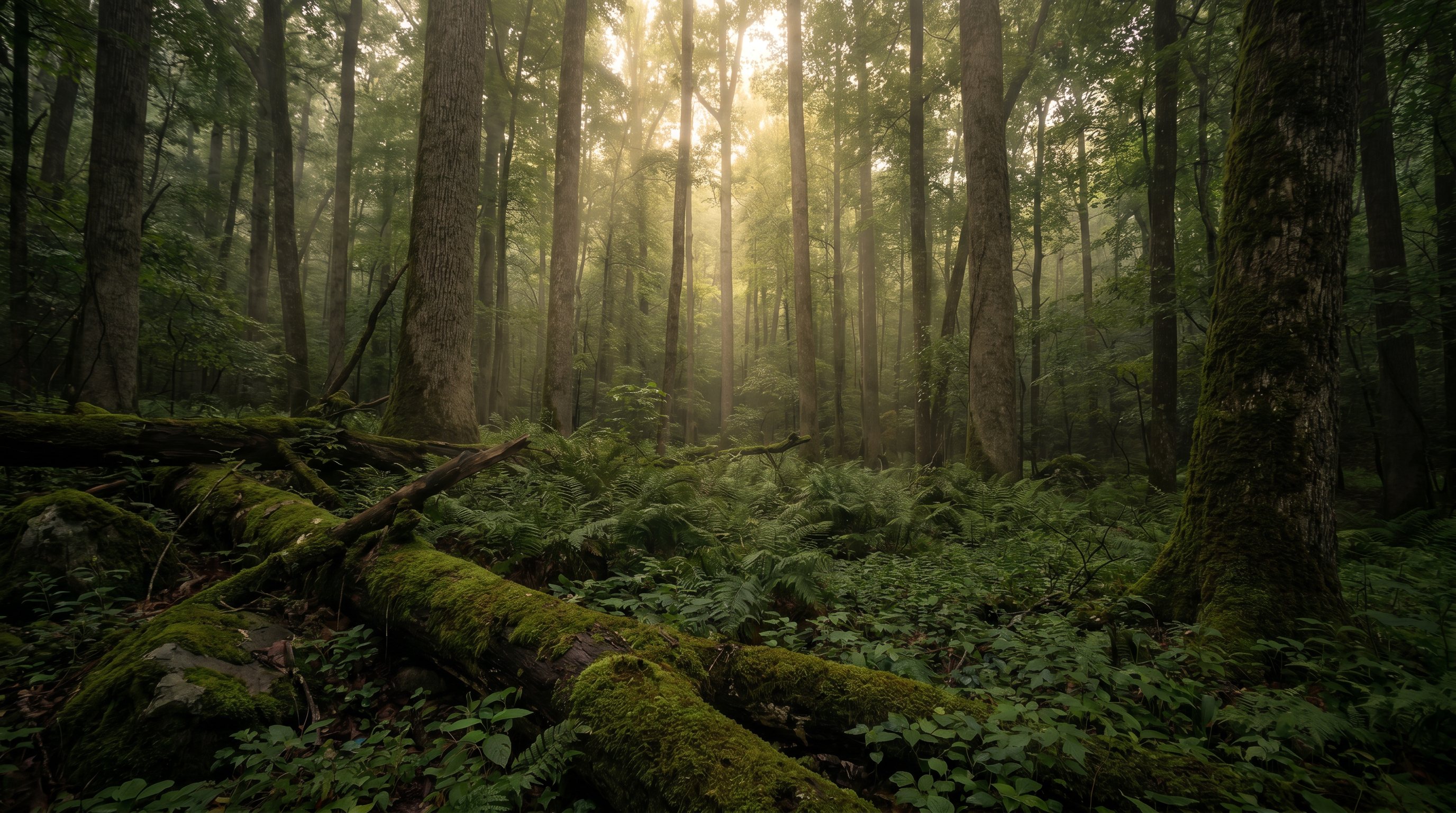
East Tennessee sits in USDA Plant Hardiness Zone 7a, where summers are humid, winters bring occasional ice storms, and the surrounding ridges and valleys create dozens of microclimates. The result is one of the most diverse hardwood forest regions in North America — and one of the most demanding environments to maintain healthy mature trees. This guide compiles the most current research from UT Extension, the USDA, and certified arborists into one comprehensive reference for Knoxville and Knox County homeowners.
1. Native Tree Species in East Tennessee
According to the Tennessee Department of Agriculture's Forestry Division, the state contains more than 180 native tree species. In Knox County, the most common shade and yard trees include:
- White Oak (Quercus alba) — The dominant hardwood across Knoxville. Long-lived (200+ years in healthy conditions), structurally strong, and the state tree of Connecticut and Illinois. Tennessee's most common oak.
- Tulip Poplar (Liriodendron tulipifera) — Tennessee's state tree. Fast-growing (24+ inches per year when young), tall (often 80-120 feet at maturity), and known for distinctive tulip-shaped flowers in May.
- Red Maple (Acer rubrum) — Common across residential yards. Brilliant fall color. Moderately fast-growing.
- Eastern Red Cedar (Juniperus virginiana) — Native conifer, drought-tolerant, often the first tree to colonize old fields.
- Shortleaf Pine (Pinus echinata) — Native pine, susceptible to the Southern Pine Beetle (see pest section below).
- Hickory (Carya species) — Several species including shagbark, mockernut, and pignut. Slow-growing, exceptionally hard wood.
- Flowering Dogwood (Cornus florida) — Tennessee's official state tree-for-flowering trees. Susceptible to dogwood anthracnose in shaded conditions.
For complete species identification, the Virginia Tech Dendrology resource is the most comprehensive online tree ID database covering East Tennessee species.
2. Seasonal Care Calendar
The ANSI A300 pruning standards (the industry standard cited by the Tree Care Industry Association) recognize that different species require different timing windows. Here's the Knox County calendar:
| Month | Activity | Why |
|---|---|---|
| December–February | Major structural pruning, especially oaks | Dormancy, no oak wilt beetle activity |
| March | Hazard assessment, mulching | Pre-storm prep |
| April–June | Fertilization, planting, NO oak pruning | Active growth + oak wilt risk |
| July–August | Watering during drought, pest monitoring | Summer stress period |
| September–October | Pre-winter inspection, light pruning | Trees beginning dormancy |
| November | Pre-ice walk-around, mulching | Winter storm prep |
For detailed pruning timing by species, the UT Extension SP611 publication on pruning ornamental trees is the most authoritative free resource available.
3. Pests and Diseases Active in Knox County
According to the USDA Forest Service Forest Health Protection Southern Region, the following tree pests and diseases are currently active in East Tennessee:
Emerald Ash Borer (Agrilus planipennis)
An invasive beetle that has killed tens of millions of ash trees across the eastern United States since arriving in 2002, according to USDA APHIS data. Tennessee was officially declared infested in 2010. Knox County now has confirmed infestations across most ash populations.
If you have an ash tree (Fraxinus species) in your Knoxville yard, it is statistically very likely to be infected. Treatment options exist for valuable trees, but the cost-benefit favors removal for most homeowners. See our guide to identifying dying trees.
Hemlock Woolly Adelgid (Adelges tsugae)
The single greatest threat to Eastern Hemlocks (Tsuga canadensis) in the Smoky Mountain foothills. According to the National Park Service, more than 80% of the hemlock canopy in Great Smoky Mountains National Park has been affected, with significant mortality reported across Blount County and the Maryville area.
Oak Wilt (Bretziella fagacearum)
A fungal disease spread primarily by sap-feeding beetles. Red oaks die within weeks-to-months; white oaks may take years. The USDA Forest Service Insect & Disease Leaflet #29 is the authoritative reference for identification and management.
Critical rule: Do not prune oaks between April and July when beetle activity peaks. We cover this in detail in our when to trim oaks in East Tennessee guide.
Southern Pine Beetle (Dendroctonus frontalis)
Native bark beetle that periodically reaches outbreak populations in East Tennessee pine stands. The Tennessee Division of Forestry monitoring data shows fluctuating populations year-to-year, with elevated risk in drought conditions. Loblolly and Shortleaf Pines are most vulnerable.
Hypoxylon Canker
A fungal opportunist that attacks stressed oaks, particularly during and after drought. According to NC State Extension, characteristic black sooty patches appear on infected trees. Once visible, the tree is typically beyond saving — removal is recommended.
Bradford Pear Decline
Not a disease per se, but an emerging crisis: virtually all Bradford Pears planted in Knoxville in the 1990s are reaching end-of-life due to inherent structural defects. The Tennessee Department of Agriculture lists Bradford Pear as an invasive species. See our Bradford Pear removal guide.
4. Pruning Best Practices (ANSI A300)
Professional pruning follows ANSI A300 (Part 1) – Pruning, the American National Standard developed by the Tree Care Industry Association. The core principles:
- Never remove more than 25% of the live canopy in a single pruning event
- Never "top" a tree — flat-cutting upper branches creates structural weakness, attracts disease, and shortens the tree's life by decades
- Cut just outside the branch collar — the swollen ring of tissue where the branch joins the trunk — to allow proper healing
- Avoid leaving stubs longer than the branch diameter
- Three-cut method for larger branches to prevent bark tearing
The ISA's TreesAreGood resource provides excellent diagrams of proper pruning cuts that every homeowner should review before any DIY work.
5. Watering and Fertilization
Per UT Extension guidance, established mature trees in Knoxville generally require no supplemental watering in normal precipitation years. During declared drought (monitored by the U.S. Drought Monitor), water deeply once per week — soaking soil to 6-8 inches deep within the drip line.
Fertilization is rarely needed for mature trees in established East Tennessee yards. The natural leaf litter and soil organic matter typically provide adequate nutrition. Soil testing through the UT Soil, Plant, and Pest Center ($15-$20) is recommended before any fertilization decisions.
6. Tennessee Tree Regulations and Property Law
Trees in residential yards are generally not regulated at the state level, but several local rules apply:
- Knox County / City of Knoxville requires no permit for removal of trees on private residential property in most cases
- Historic districts (including Old North Knoxville and parts of Fourth & Gill) may have specific tree preservation requirements
- KUB right-of-way trees are managed by the utility — you may not interfere with vegetation in the easement
- State right-of-way (along highways and TDOT roads) requires Tennessee Department of Transportation approval
For property line disputes involving trees, see our detailed Tennessee tree law guide.
7. When to Call a Professional Arborist
The ISA Certified Arborist credential is the most rigorous professional qualification in tree care. You should contact a certified arborist (or an experienced tree service) for:
- Any pruning work above ladder height
- Removal of trees over 25 feet tall
- Trees near power lines or structures
- Hazard assessment of leaning or damaged trees
- Diagnosis of suspected disease or pest infestation
- Storm damage cleanup
- Pre-construction tree protection planning
You can verify any tree professional's ISA certification at the official ISA arborist locator.
8. Local Knoxville Resources
- UT Extension Knox County — Free educational resources, soil testing, master gardener consultations
- Tennessee Division of Forestry — Free tree health assessments, reforestation programs
- Knoxville Utilities Board — Tree-near-power-line reporting and trimming requests
- Knoxville News Sentinel — Local storm damage reporting
- Great Smoky Mountains National Park — Regional tree health research and education
Putting It All Together
Healthy East Tennessee trees require three things: (1) species-appropriate care, (2) seasonal timing awareness, and (3) early intervention when problems arise. The single biggest preventable failure pattern we see in Knoxville is homeowners discovering a hazard tree only after a storm has dropped it on something valuable — when a proactive assessment 6-12 months earlier could have prevented the entire event.
For a free hazard assessment on your Knox County property, call (865) 348-3063 or use the form on this page.