
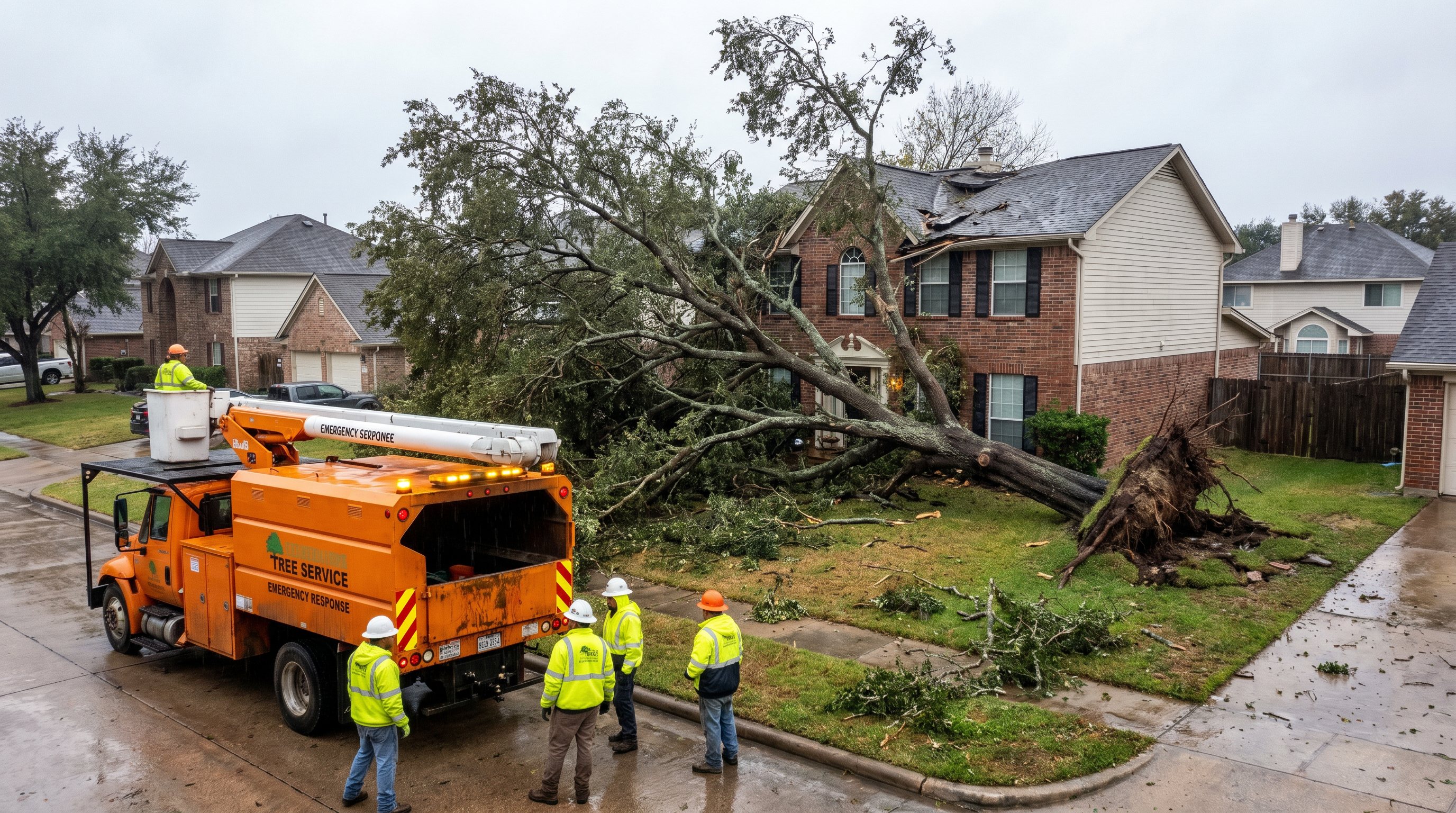
Two things are converging over East Tennessee right now, and together they turn ordinary backyard trees into serious hazards. First, the 2026 severe weather season is shaping up to be an active one across the Tennessee Valley, with forecasters warning of a busier-than-normal storm pattern. Second, the emerald ash borer — the invasive beetle first found in the United States right here at a Knox County truck stop in 2010 — is now confirmed in 67 of Tennessee's 95 counties and is killing ash trees across the region. A dead or weakened tree and a 60 mph wind gust are a dangerous combination. This guide walks you through how to spot a hazard tree on your Knoxville property in 2026, what removal actually costs, and exactly when to pick up the phone.
Why 2026 Is a High-Risk Storm Year for Knoxville Trees
The National Weather Service office in Morristown has tracked repeated rounds of showers and thunderstorms moving through the Knoxville area through late spring and into early June 2026, and AccuWeather forecasters flagged the 2026 severe weather season as one that may ramp up faster and hit harder than usual. June highs in Knoxville are already running into the upper 80s — the kind of warm, humid air mass that fuels afternoon and evening thunderstorms capable of producing damaging straight-line winds.
High wind does not need a tornado to do damage. A single rotten limb or a root-compromised hardwood can come down on a roof, a fence, a car, or a power line during a routine summer storm. The trees most likely to fail are the ones that were already weakened — by disease, decay, or pests — long before the wind arrived. That is where the second half of this story comes in.
The Emerald Ash Borer: Knox County's Silent Tree Killer
The emerald ash borer (EAB) is a small, metallic-green beetle that attacks and kills every species of North American ash tree. According to the Tennessee Department of Agriculture's Protect TN Forests program, it was first discovered in the U.S. in Michigan in 2002 and was identified in Tennessee at a truck stop on I-40 in Knox County in July 2010. Since then it has spread to 67 of Tennessee's 95 counties. Infested trees typically die within two to four years of the first visible signs, and once a tree is more than about 50% dead, it generally cannot be saved by treatment.
Emerald Ash Borer Spread in Tennessee
Confirmed in 67 of Tennessee's 95 counties as of 2026 — roughly 7 in 10.
Here is why this matters for storm season: adult ash borers are active and visible from June through August — right now. A dying ash holds onto brittle, decaying wood that snaps easily in wind. Many of the “surprise” tree failures we respond to after a storm are ash trees that were already hollowed out from the inside by EAB. We cover the biology and treatment math in depth in our emerald ash borer in Tennessee guide.
How to Tell If You Have a Dying Ash Tree
- Canopy thinning & dieback — the top of the tree looks sparse or bare while lower branches still leaf out.
- D-shaped exit holes — tiny, distinctive 1/8-inch holes in the bark where adult beetles emerged.
- Heavy woodpecker activity — birds stripping bark to reach larvae, leaving light patches called “blonding.”
- Bark splits revealing S-shaped tunnels (galleries) underneath.
- Epicormic shoots — clusters of new sprouts emerging directly from the trunk or base, a stress signal.
If you can identify an ash tree on your property — opposite branching, compound leaves with 5 to 11 leaflets, and diamond-shaped bark ridges on mature trunks — and you see any of these signs, treat it as a potential hazard before the next storm.
7 Warning Signs Your Tree Is a Hazard
You don't need to be an arborist to spot a tree that's asking for trouble. Walk your property and look for:
- A noticeable lean that has gotten worse, especially toward a house, deck, or power line.
- Soil heaving or lifting roots on one side of the base — a sign the root plate is failing.
- Cracks or splits in the main trunk or where large branches join.
- Dead branches in the upper canopy that no longer leaf out.
- Mushrooms or fungal growth at the base, which often signals internal rot.
- Hollow or soft spots in the trunk that sound different when tapped.
- D-shaped exit holes or canopy dieback on ash trees (see the EAB section above).
Any one of these is worth a professional look. A combination of two or more, especially near a structure, is a reason to schedule a hazardous tree assessment before storm weather arrives. Our full guide to the signs a tree is dying goes deeper on each one.
What to Do When a Tree Falls or Is Damaged in a Storm
- Stay clear and stay safe. Do not approach a fallen tree until you've checked for downed power lines.
- If a power line is involved, call the utility first. Contact KUB (or your local provider) before anyone — including us — touches the tree.
- Call for emergency tree service. Our 24/7 line is (865) 348-3063. We respond across Knox County any hour for trees on roofs, fences, vehicles, or blocking access.
- Document for insurance. Photograph the damage from several angles before anything is moved — this helps your homeowner's claim. See our tree-fell-on-house insurance guide.
- Don't move the firewood. If the tree was an ash, moving untreated wood can spread the ash borer to new areas. We haul and dispose of it properly.
What Tree Removal Costs in Knoxville in 2026
Most residential tree removals in the Knoxville area run between $400 and $1,200, though the full range stretches from about $300 for a small ornamental to $2,500 or more for a large hardwood next to a structure. The biggest cost drivers are size, proximity to your house or power lines, and how much rigging or crane work the job requires.
2026 Knoxville Tree Removal Cost Ranges
Typical price by tree type and situation (scale: $0–$3,000+).
| Tree / situation | Typical 2026 Knoxville range |
|---|---|
| Small ornamental, under 30 ft (open yard) | $300 – $600 |
| 40–50 ft Tulip Poplar (open yard) | $500 – $800 |
| 40–60 ft hardwood (typical job) | ~$1,000 |
| Large White Oak near a structure | $1,500 – $3,000+ |
| Emergency / storm-damaged tree on a structure | Premium — call for assessment |
| Stump grinding (6–12″ below grade) | Add-on, quoted per stump |
One timing note that can save you money: late winter (January–February) is typically the cheapest window for non-urgent removals, while spring and post-storm demand can push prices up 15–30%.
How Timing Affects Removal Price
Relative cost of the same non-urgent job by season.
If you have a dying ash or a leaning tree, it is almost always cheaper to remove it on a calm-weather schedule than as a 2 a.m. emergency after it lands on your roof. Every job starts with a free, written estimate — see our full Knoxville tree removal cost breakdown.
How to Storm-Proof Your Knoxville Trees Before the Next Round
- Schedule a hazard assessment. A professional walk-through catches problems — rot, lean, EAB — while they're still fixable.
- Prune dead and overhanging limbs. Thinning a dense canopy and clearing branches over your roof or power lines reduces wind load.
- Remove dying ash trees proactively. An ash that's more than half dead won't recover and only gets more dangerous and more expensive to remove as it deteriorates.
- Time your pruning right. Late winter or early spring before bud break is best for most hardwoods; mature trees benefit from professional pruning every 3 to 5 years. See our storm season prep checklist.
- Know your emergency contact. Save our 24/7 number now: (865) 348-3063.
Get a Free Hazard Tree Assessment Today
Don't wait for the next storm to find out a tree was a problem. Licensed, fully insured, free written estimates, and 24/7 emergency response across Knox County.
Call (865) 348-3063Frequently Asked Questions
Should I remove my ash tree if it has the emerald ash borer?
If the canopy is more than about 50% thinned or dead, the tree generally cannot be saved by treatment and should be removed before it becomes a falling hazard. Trees caught early may be treatable — a certified arborist can assess yours. Either way, don't move the wood, since untreated ash firewood spreads the beetle.
My tree fell on my house during a storm. What do I do first?
Check for downed power lines and stay clear — if any line is involved, call your utility (KUB) first. Then call our 24/7 emergency line at (865) 348-3063. Photograph the damage for your insurance claim before anything is moved. We respond across Knox County at any hour.
How much does emergency tree removal cost in Knoxville?
Standard removals run $400–$1,200, but emergency and storm-damage work involving a tree on a structure carries premium pricing because of the added risk, rigging, and after-hours response. We provide a clear assessment before any work begins.
How do I know if a tree is dangerous before a storm?
Look for a worsening lean, lifting roots or heaving soil, trunk cracks, dead upper branches, mushrooms at the base, hollow-sounding wood, and — on ash trees — D-shaped exit holes or canopy dieback. Any of these warrant a professional hazard assessment.
Is it cheaper to remove a tree before it falls?
Almost always. A planned removal on a calm-weather schedule avoids emergency premiums, and a controlled takedown is far less expensive than dealing with a tree that has already landed on a roof, fence, or vehicle. Late winter is typically the lowest-cost window for non-urgent jobs.
Sources
- Emerald ash borer in Tennessee — origin, Knox County 2010 detection, and June–August adult activity: TN Dept. of Agriculture, Protect TN Forests
- EAB identification & national spread: USDA APHIS
- Knoxville-area storm activity & forecasts: National Weather Service, Morristown TN
- Cost ranges reflect current Knoxville-market pricing from our own free estimate data.