Not every structural problem in a tree calls for the chainsaw. When a big, healthy shade tree develops a weak spot — two trunks pulling apart, a long limb sagging over the driveway, a crack where two leaders meet — you don't always have to choose between hoping it holds and cutting it down. Tree cabling and bracing is the middle path: a hardware support system that limits movement, shares the load, and holds weak parts together so a prized tree can keep standing for years. Our licensed, insured Knox County crews install these systems to industry standard, and we'll tell you honestly when a tree is worth supporting and when it's too far gone.
What Are Cabling and Bracing?
They're two related tools that solve the same problem — a weak structural point — in different ways.
- Cabling uses flexible steel cable installed high in the canopy, typically about two-thirds of the way up from the weak union to the branch tips. It doesn't lock limbs in place; it limits how far they can move and lets limbs share load. In a wind gust or under snow and ice, the cable keeps a weak limb from swinging or bending far enough to tear out.
- Bracing uses threaded steel rods installed through a weak union, split, or crack. Where a cable works from above at a distance, a brace rod works right at the defect, rigidly holding the two halves together so a split can't open further. Rods are common on cracked co-dominant stems and unions that have already started to separate.
Many trees get both — rods hold a split closed at the union while a cable higher in the canopy reduces the leverage that's working to pull it apart in the first place.
When Does a Tree Need a Support System?
They're the right call when a structurally significant defect threatens an otherwise sound, valuable tree. The most common situations we see across Knoxville:
- Co-dominant stems with tight, V-shaped unions. When two trunks of similar size grow up at a narrow angle, bark often gets trapped between them (included bark). That union never fully bonds and is prone to splitting — a classic candidate for support.
- Heavy, over-extended limbs. Long horizontal branches that reach out over a roof, deck, or driveway carry a lot of leverage at their base and can fail under their own weight plus ice.
- Existing cracks or partial splits. A union that has already begun to separate, or a limb with a visible crack, may be stabilized with bracing before it fails.
- Storm-damaged but salvageable trees. After a storm, some trees have a torn or cracked union that can be supported rather than removed — our storm-damage guide covers how we tell the difference.
- Large, valuable, heritage, or shade trees near a home. A mature White Oak or Tulip Poplar shading the house is worth preserving. When the only problem is one weak point, support is often smarter than removal.
Dynamic vs. Static Support Systems
You'll hear two broad approaches. Static systems use steel cable and rigid hardware — the traditional method that holds firmly and suits unions that have already cracked. Dynamic systems use synthetic rope with some built-in give, allowing a controlled amount of natural sway so the tree keeps building its own reaction wood and strength. Each has its place; the right choice depends on the defect, the tree's health, and how much movement is safe. Part of a professional assessment is matching the system to the tree rather than defaulting to one method for everything.
Installed to ANSI A300 Standards
This is where professional work separates itself from a well-meaning mistake. Support systems should be installed to the ANSI A300 (Part 3) standard for tree support systems, which governs hardware sizing, anchor placement, and installation technique. A cable is only as good as its weakest anchor and its position in the canopy. The hardware-store approach of wrapping a chain or cable around two limbs is worse than doing nothing: it can girdle the tree, choke off the tissue it wraps, and give way in the exact storm you installed it for. Standards-based installation, with properly sized through-hardware anchored into the wood, is what makes a system durable and load-appropriate.
Wondering If Your Tree Can Be Saved?
Get a free written assessment from a local Knox County crew. Licensed & insured, honest recommendations, no pressure to remove a tree that can be supported.
Call (865) 348-3063A Lower-Cost Alternative to Removing a Prized Tree
Here's the part homeowners are relieved to hear: cabling and bracing is frequently a fraction of the cost of removing a large hardwood. A big oak or poplar near the house is expensive to take down, and once it's gone you've lost decades of shade and property value that no replacement restores for a generation. When a tree is fundamentally sound and the only issue is a single weak union or an over-extended limb, a support system that reduces failure risk is usually the smarter choice. Pair it with routine tree trimming to reduce end-weight on heavy limbs and ongoing plant health care, and you have a real preservation plan rather than a gamble.
When Support Is NOT the Answer
Being honest about the limits matters. Cabling and bracing support a living, structurally repairable tree — they do not cure a dying one. A cable can't fix internal decay, and a brace rod can't restore strength to a hollow or badly rotted trunk. If the tree is dead or more than roughly half dead, extensively hollow, or riddled with advanced rot, hardware just delays an inevitable and more dangerous failure. Those trees belong in the tree removal conversation. Before we ever recommend a system we check for the warning signs in our guides to a dying tree and a hazardous tree, and if a tree is genuinely unsafe, we'll say so.
How the Process Works
From your first call to a finished, standards-based system, here's what to expect:
- Free on-site assessment. We evaluate the tree's health, the specific defect, its location relative to structures, and whether support is realistic. If removal is the safer call, we tell you.
- System design. We determine how many cables, where they anchor, whether brace rods are needed, and whether a static or dynamic approach fits — all sized to the tree per ANSI A300.
- Written estimate. You get the scope and a clear price in writing before any work starts.
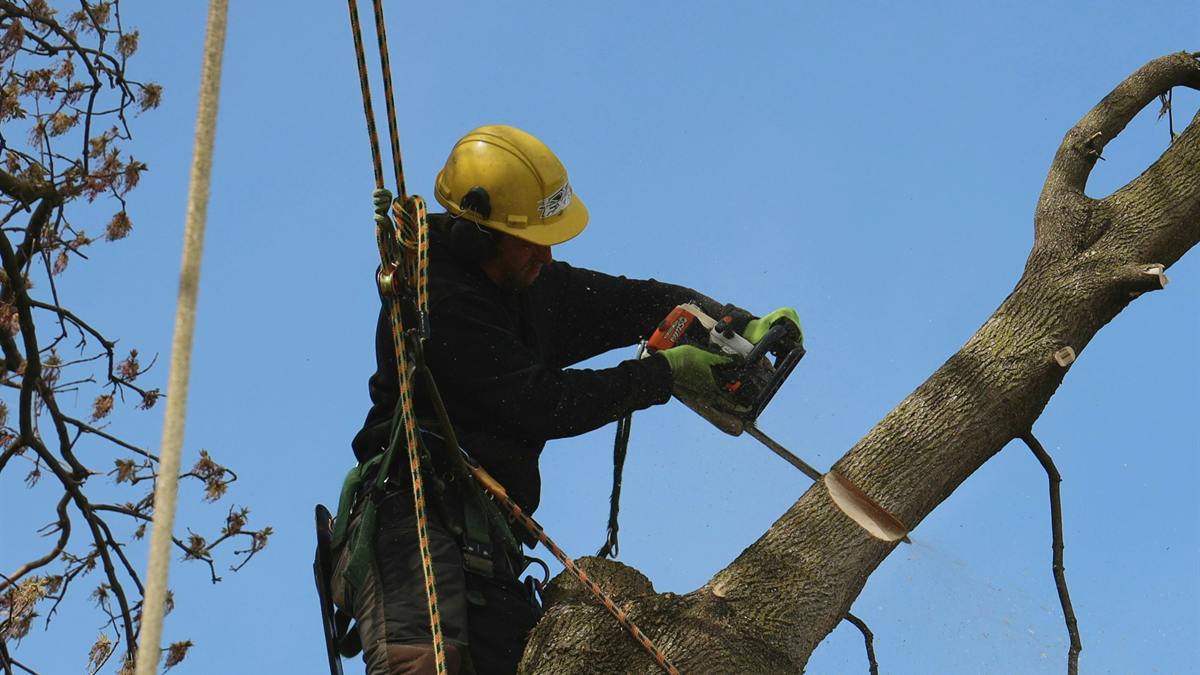
- Professional installation. Climbers install anchors and hardware at the correct heights and tension, without damaging the tree.
- Complementary pruning and inspection plan. Where it helps, we reduce end-weight on the supported limbs, then set up a re-check schedule so the hardware is monitored over time.
What Does Tree Cabling & Bracing Cost in Knoxville?
Costs are best presented as ranges, because the price is driven by three things: the number of cables the tree needs, the height of the tree (which sets how much climbing and rigging is involved), and the amount of hardware — brace rods add material and labor. As a general guide for the Knoxville area:
| Support system / situation | Typical Knoxville range |
|---|---|
| Single cable, small to mid-size tree | $200 – $450 |
| Two cables, mid-size tree (co-dominant stems) | $400 – $750 |
| Multiple cables, tall hardwood | $750 – $1,200 |
| Threaded brace rods at a split union (per rod set) | Add-on — quoted per union |
| Large heritage tree, cables + bracing combined | $1,200 – $1,500+ |
| Periodic inspection / hardware re-check | Quoted per visit |
These are typical ranges to help you plan, not a quote. For how support work fits alongside other tree costs, see our Knoxville tree service cost guide, and for the bigger picture, the complete guide to tree care in East Tennessee.
Support Systems Need Periodic Inspection
A support system is a long-term relationship, not a one-time fix. Trees grow, and the wood around anchors changes over the years — hardware can loosen, corrode, or become undersized as limbs put on girth. That's why the standard practice is to inspect the system periodically, often every one to a few years, checking the cables, anchors, and surrounding tissue and adjusting or replacing hardware as needed. We build a re-check schedule into every install and can also inspect systems another company or a previous owner put in. A cable you forget about for fifteen years isn't protecting anyone.
Preserving Trees Across Knox County
East Tennessee's big hardwoods — White Oak, Tulip Poplar, Hickory, Red Maple — are exactly the species that develop co-dominant stems and heavy lateral limbs worth supporting, and they grow on the sloped, storm-exposed lots common across the county. We serve homeowners throughout West Knoxville, Farragut, North Knoxville, South Knoxville, Maryville, and Oak Ridge. For business sites, our commercial tree services include structural support for high-value landscape trees, and when a storm-cracked tree can't be saved, our emergency tree service and crane tree removal crews handle the takedown safely.
Frequently Asked Questions
How much does tree cabling and bracing cost in Knoxville?
Most jobs run $250–$1,200. A single cable may be $200–$400, while a large heritage tree needing multiple cables plus bracing rods can reach $1,500+. The number of cables, tree height, and hardware drive the price, and every job starts with a free written estimate.
Will cabling save a tree that is dead, hollow, or badly rotted?
No. Support systems stabilize a living, sound tree with a specific weak point; they don't cure decay or bring back a dead tree. If the trunk is hollow, badly rotted, or more than about half dead, removal is the safer answer — we check for the signs of a dying tree first.
What is the difference between cabling and bracing?
Cabling uses flexible steel cable high in the canopy to limit limb movement and share load. Bracing uses threaded steel rods through a weak union or split to rigidly hold it together. Many trees benefit from both.
How long does a support system last, and does it need maintenance?
It can serve for many years, but it isn't install-and-forget. Cables, hardware, and the surrounding wood should be inspected periodically — commonly every one to a few years — because trees grow and hardware can loosen or corrode.
Is cabling cheaper than removing the tree?
Often, yes — especially for a large, valuable tree near your home. Supporting a sound tree with one weak point is frequently a fraction of the cost of removing a big hardwood and losing decades of shade and property value.
Does the work follow an industry standard?
Yes. Support-system installation follows ANSI A300 (Part 3), covering hardware selection, placement, and technique. That standard is what separates a durable system from a hardware-store cable wrapped around a limb, which can girdle the tree and fail under load.
Schedule a Free Tree Assessment
Call (865) 348-3063 or use the form for a free written estimate. We'll evaluate whether cabling and bracing can preserve your tree — and give you an honest answer either way — across Knoxville and all of Knox County.